Research at the University of Houston
During my time at the University of Houston, I was doing research and became involved in aerospace-related projects. While there, I joined the AIAA-UH Space City Rocketry team, focused on rocket design and experimental rocketry.
Being part of the team allowed me to work in a real aerospace environment, collaborate with other engineers, and participate in the full lifecycle of rocket design: design, testing, integration, and launch.
My own rockets: IZAR rockets
Alongside the team work, I designed and built my own rockets, fully independently. These rockets were part of my personal learning path and my certification process with Tripoli.
The rockets were:
- IZAR-1
- IZAR-2
- IZAR-3
For these rockets, I designed everything myself:
- rocket configuration
- onboard electronics
- flight computer
- firmware and software
- ground testing and launch preparation
These were real flying rockets, designed to work in real conditions, not simulations.
IZAR-1 – Tripoli Level 1
IZAR-1 was used to obtain my Tripoli Level 1 (L1) certification. It was my first high-power rocket flown with a fully custom avionics system.
This flight was especially important because it was the first time flying electronics and software fully designed by me in a real certification launch.
 IZAR 1 Rocket.IZAR 1 L1 certification flight.
IZAR-2 and IZAR-3 – Tripoli Level 2
IZAR-2 and IZAR-3 were part of my Tripoli Level 2 (L2) certification process, which I ultimately obtained with custom electronics.
IZAR-2 failed during flight, which forced me to analyze the failure, review the design, and improve both the rocket and the onboard systems. Based on what I learned, I designed and built IZAR-3, applying the corrections and improvements needed.
 IZAR 2 Rocket.IZAR 2 crash.
The successful flight of IZAR-3 validated not only the rocket design, but also the onboard computer, firmware, and overall system integration. These flights required a higher level of reliability, safety, and testing, and they were a key step in my development as an engineer.
IZAR 3 L2 certification flight.Custom onboard computer (IFC)
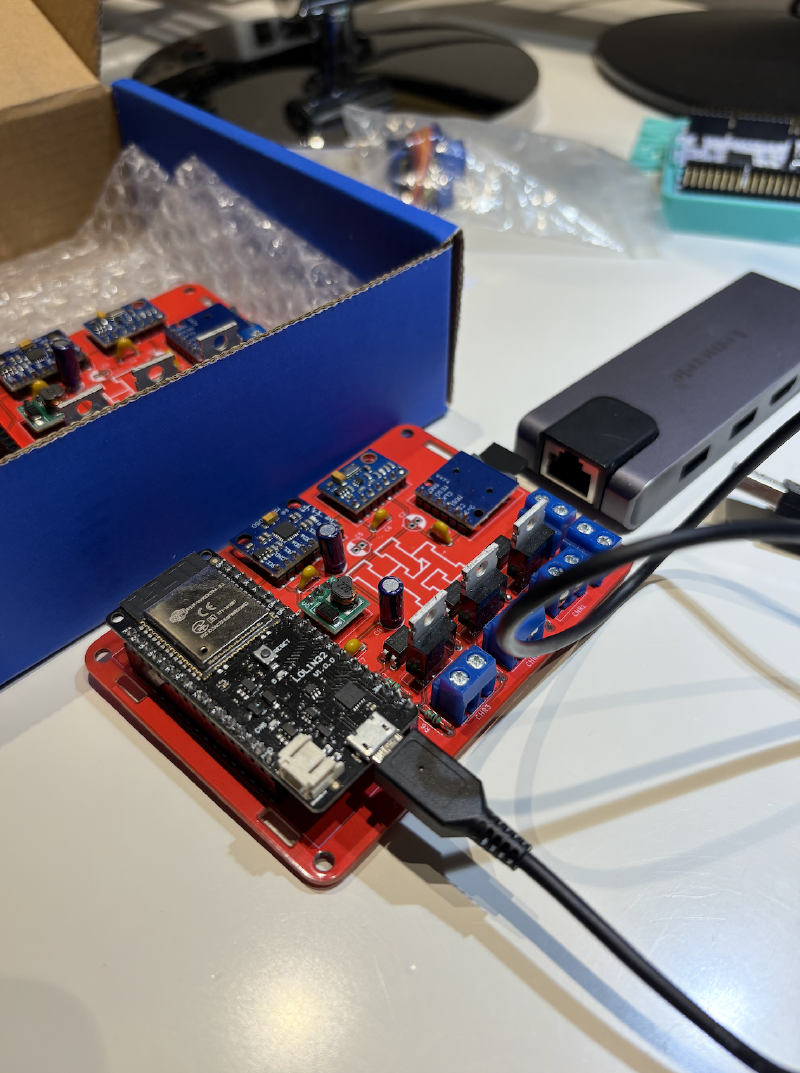
For the Tripoli certifications, I designed my own onboard computer, both hardware and software. This is the Izar Flight Computer (IFC).
 IZAR Flight Computer.
Project links:
- 📂 Repository: https://github.com/imanolpg/ifc
- 🌐 Project page: https://imanolpg.github.io/ifc/
The IFC was designed to:
- collect and log flight data
- manage sensors
- control rocket states safely
- serve as a base for future expansion (telemetry, logging, control)
I designed:
- the electronics
- the PCB
- the firmware
- the software architecture
In addition to the onboard system, I also designed a custom mobile application to interact with the IFC.
Through this mobile app, it was possible to:
- monitor the rocket state in real time
- receive live telemetry during operation
- control and change rocket states safely
- interact with the system in a clear and controlled way
The mobile application was a key part of the system, allowing safe interaction with the rocket electronics and giving full visibility of what was happening onboard, both on the ground and during flight.
The objective of the IFC project was to fully understand how avionics systems work in real rockets, instead of using commercial black-box solutions. Every design decision, from hardware to firmware and user interaction, was made and implemented by me.
AIAA-UH Space City Rocketry & IREC 2025
In addition to my personal rockets, I worked with the University of Houston Rocket Team on the design and launch of the team rocket Foenix.
Together, we designed, built, and launched the rocket at IREC 2025 (International Rocket Engineering Competition), held in the Texas desert.
Launching at IREC meant working at a much larger scale: strict safety procedures, complex logistics, and coordination with a large international competition.
 IREC team.
Payload award – IREC 2025
At IREC 2025, our team won the Payload Award, recognizing the best payload of the competition.
The payload was a G-forces experiment applied to sea urchin sperm, designed to study how high acceleration environments affect biological samples during flight.
Winning this award was a strong validation of the technical and scientific quality of the work done by the team, and a highlight of the entire experience.
 IREC winning price.
Why this project is important to me
This project represents:
- real aerospace engineering
- full ownership of hardware and software
- systems that must work once, under real conditions
From avionics design to certification flights and international competition launches, this experience strongly shaped how I understand engineering today:
design carefully, test seriously, and fully understand what you build.